
 EN
EN

How to Realize Zoned Management of Hotel Guest Room Safes
Let me tell you what is not keeping hotel managers up at night. Noisy guests? Coffee complaints? No, it's the hotel safes. One of the most valuable items a guest could possess is a passport, and the list of valuables that could be stored in a hotel safe is extensive. Considering the multi-faceted issues involving hotel guest safes, they are a guest manager's dilemma. More than anything, with the loss of a safe or a malfunction, you can be sure of one unhappy guest.
I know enough hotel people and their stories. There are so many guests including those whose codes they have forgotten and the guests who have experienced extreme battery failures, and guests who have experienced safe failures with no apparent reason. Add in the suffering front-desk staff who have to deal with these guests as they stand there resolutely tapping their feet.
Modern hotel safes have become increasingly sophisticated and with a little effort, they can be kept under control. This is what we refer to as zoned management.
What Zoned Management Allows You to Do
What does the term zoned management refer to? Consider your hotel. You probably have multiple guest levels. Different types of rooms. You might have standard rooms on the lower levels, Then on the higher levels, you might have executive suites or long term stay apartments. Each of these zones may require a different management approach when it comes to safety.
When it comes to zoned management, you can handle each zone independently. Different floors can have different configurations. Different staff within different access roles can have varying access. In certain hotel zones, you can have different audit trails. It's about giving you control - sensibly - based on the operations of your hotel.
The previous approach involved one size fits all. All staff had the same access to the hosts. Every staff member had the same access. It was easy, but very basic. You were not able to do anything special for your VIP floors. You were not able to restrict access for housekeeping on certain levels. Management essentially did nothing as the safes just sat there doing nothing - and just hoped nothing went wrong.
Innovative Safes
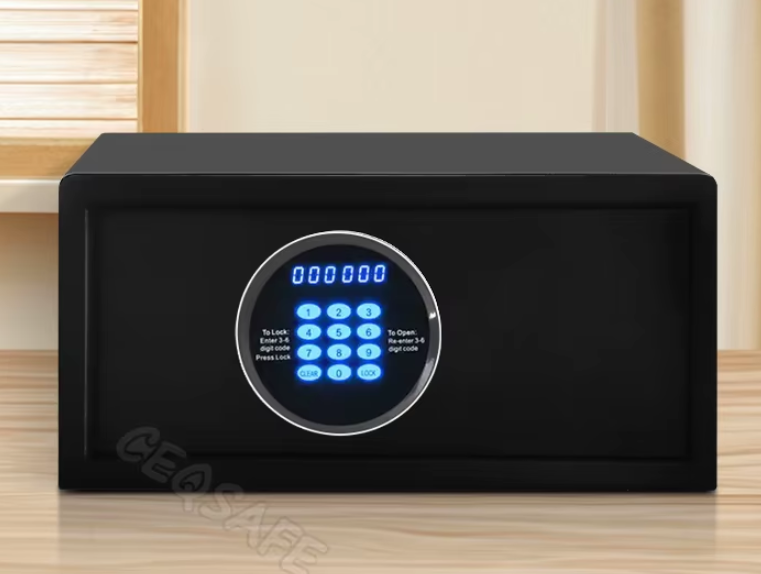
The most advanced safes are housed in hotel rooms and offer a variety of features. The new technological upgrades come with a digital keypad and backlit screen and can offer the hotel additional features.
The E2042YK model was designed only for hotel use. It is the perfect size for a guest room closet. It is large enough to hold a 17” laptop while still providing room for plenty of other items a business traveler might have. At the same time, guests can travel with peace of mind knowing the safe is large enough to hold a large number of additional valuables, such as wallets and watches.
The steel in the door can be as thick as 5mm. The door is constructed of Q235 steel. If someone were to try and forcibly open the safe, they would be unsuccessful due to the hidden hinges and a door design that minimizes weak points to the maximum.
Now, we haven't talked about the electronics yet, and that is where the magic happens. We could talk about an LED display that is actually readable, a backlit keyboard that allows guests to see what they are typing in the middle of the night, a door sensor that turns on the light when the door opens, and a light that turns on when the door opens. We could talk about all the little things that make a huge difference when you are half asleep and just want to put your passport away in the safe.
Modes for Different Types of Guests
Here is an idea worth a gold star. Modern hotel safes now have two Operating Modes. Short term mode and Long term mode. And that is ideal for zoned management.
Consider this for a moment. Most hotel guests stay for a very short time. They want something really simple. They check in, they set a code, they use it for a couple of nights and then they forget about it. That is short term mode. Each new guest sets a new code. It's all very new, secure, and there is no confusion about who used it last.
What do you do for guests with extended stays? They book for a month or more. In some cases, you might have corporate apartments where the same individual stays for weeks. For these guests, short-term mode can be particularly irritating. They do not want to reset the code every few days. Instead, they want to be able to set it and forget it.
This is where long-term mode is helpful. One code, permanent until they decide to change it. The guests appreciate the convenience, and you appreciate not having to deal with it.
When you set up zoned management, you can assign different levels to different configurations. For example, floors two through five might have short term mode to accommodate regular tourists. The executive floor might have long-term mode for your corporate frequenters. You decide and the system does the rest.
Administrator Password
Let’s also discuss who is really in control, the hotel manager, or the front desk supervisor, or whoever manages the safes. They all need access, but not in the same way the guests do.
Here’s where the administrator password comes in. This is a type of master code that could open the master safe of any hotel safe, However, it is not for guests. It is for employees, and it is only for certain scenarios. A guest could forget their code. No problem. Employees can use the administrator password to open the safe. -BUT- The safe keeps track of, and records, each and every single use of that administrator password. So if somebody is opening hotel safes that their not supposed to, Management will know.
With zoned management, different areas can have different administrator passwords. A housekeeping supervisor on the fifth floor might have a code that only works and opens the fifth floor. A maintenance worker might have a code that works for all floors but only for specific times. You decide.
The Audit Trail
Speaking of track, we have audit trails. This is one of those features that you don’t pay attention to until you really have to use it, and when you have to use it, you really have to use it.
The audit trail includes information such as every administrator password used, every invalid code entry, and every time the safe was accessed.
What if you need access to that information? You need to use a CEU device to plug into the safe and download the audit trail.
This may seem tedious, but this could be the most important part of your case. For example, If a guest claims their valuables are missing, you can use the audit trail to determine if anyone aside from the guest accessed the safe. You may even be able to determine if the administrator password was used.
This also can work with zoned management, where you can set the audit monitors at different times for different zones. For instance, you may set the audit monitors to work more frequently on the executive floor. You may even set different floors to work at different times.
Emergency Access
A good plan won’t ensure everything goes as expected. Batteries can die, electronics can fail, and guests can do the unthinkable. That’s why you need a backup plan.
Most hotel safes have emergency key locks, with the emergency keys stored in very secure locations, to be used in emergencies.
These keys are an excellent part of the system, as they are able to be used in many scenarios where the system has failed. The key system does not have a dead battery, the electronic locks did not fail, and they can be used to avoid an imminent missed flight situation.
With zoned management, you have control over where the emergency keys are stored. You can determine if they will be distributed to each floor, stored together at the front desk, or kept in the security office.
The Most Important Element
When it comes to the safes, electronics are not the most important part of the box. The vault is what dictates the quality, and if it is not built to last, then it is not built well.
A quality hotel vault is built with extreme durability. The vault door will have at least 3-5 mm of solid steel, and be finished with body walls of 1-2 mm. The door will be secured by 2 bolts, each 19 mm in diameter which is some serious hardware.
It is important to focus on surface treatment too. For example, rust proofing and environmentally friendly powder coating. This has nothing to do with aesthetics and everything to do with functionality. Hotel safes are used hundreds of times every year. They get rammed and banged into, and cleaned with all sorts of nasty chemicals. They need to endure.
And then there is the matter of weight. The E2042YK for example, weighs between 8.5 to 10.5 kilograms. This is heavy enough to ensure that the safe cannot simply be walked away with. But is also light enough not to provide challenges during the installation.
Installation and Positioning
And then, how about the location of the safes? This is where zoned management comes in. Depending on the room type, the safe location may also be varied.
For example, standard rooms may have the safe inside the closet. Out of sight, but still easy to access. In executive suites however, the safe may be placed inside a drawer, or built into the furnishings for a more integrated appearance. In extended stay apartments, a larger, even floor-model safe is likely to be placed because guests tend to have more belongings.
Through zoned management, different models can be selected for different zones. The E2042 series has multiple size options. H200W420D370 is for 14 inch laptops. H200W450D370 is for 15 inch laptops while H200W465D370 is for 17 inch laptops. Choose the appropriate size based on the room type.
Educate Your Team
Any system, even the best one, becomes worthless without employee training. Your team needs guidance, your organization needs protocols, and your employee education needs standardization.
Zoned management allows specific training to target individual staff roles. For example, front desk personnel manage the administrator password, housekeepers control the emergency keys, and maintenance staff are trained to replace batteries and troubleshoot. Different roles require different training.
The safes are digital and training becomes even simpler. The safe displays step-by-step training for use, relieving staff from memorizing procedures from a training manual.
The Customer Journey
The most important element of this process is the guest. Customers do not find management systems or audit trails as useful as a safe where they can store and access items without hassle.
When a hotel safe is functioning properly, it becomes a good safe. Guests can set codes and use the safe without any further consideration. This is the desired outcome.
Most of the time, the safes function well, but when the systems fail, the safes become a glaring issue. This is one of the places where the customer system matters most. An upset customer is one that has to wait 20 minutes for a staff member to figure out what to do, but a happy customer is one that has to wait 2 minutes to get a code reset.
When it comes to problem-solving, zoned management comes to the rescue. With zoned management, staff have a better understanding of the resources available to them. As a result of this, the customer has a better experience, and the business retains more of a competent, organized demeanor.
Why This Matters for Your Hotel
Guests do not book a hotel because of the safes, but guests will not return because the experience with a hotel safe is bad.
Think of the reviews you have seen with negative comments about a hotel sending a staff member to the safe and how that affected your hotel. You have brilliant ideas, and you have seen reviews like that.
Negative reviews like this will become positive with your excitement about this service and will increase the reviews with comments like 'the staff was wonderful' because the staff are the most important part of a hotel and all the hotels are selling.
With zoned management, you can pro-actively manage issues before they become problems.
A Company That Gets It
CEQSAFE and other manufacturers get the hotel industry. They understand the difficulty of the industry and what works and what doesn’t.
Consider their hotel safes. They are made for the hotel industry and not just safes for home use that have been altered.
There are hotel-specific features such as dual modes, administrator passwords, audit trails, emergency keys, etc.
They have UL94, CE, FCC, RoHS, and ISO1182 certifications which not just letters but represent a the standard they are marked with.
The Bottom Line
Your headaches over hotel safes can be eliminated by a smart approach. Managing hundreds of safes in a low stress environment is possible.
It starts with the right tools. Hotel room digital safes designed specifically for the task. With the required features to manage them efficiently.
Then you add zoned management. Varied control for varied zones. Varied access for varied personnel. Varied audit trails for different segments of the hotel.
Finally, you educate your staff. Ensure that everyone knows what to do and the appropriate times to do it.
The outcome is a working system. Guests are content because their belongings are safe and easy to access. Staff have the pleasure of easily solving problems. And management enjoys the peace of not having to deal with a high volume of complaints.
It starts with the safes, that is what effective hotel management is.

