
 EN
EN

Why Do Hotels Require Guest Room Safes to Have 5 Sets of Management Passwords?
Every hotel needs to consider how to best protect their guest's property. That's why the best hotels see how guest room safes are more than just a convenience; they are a part of key operations and safety. It makes perfect sense that many hotels mandate that guest room safes come with a minimum of 5 sets of management passwords. While it may seem like a lot of passwords to manage if you consider the operation of hotels, guest safety, and risk management with the help of some industry experts and some popular hotel brands like CEQSAFE. This article will help clarify and educate why 5 sets of passwords is now standard for hotel guest room safes.
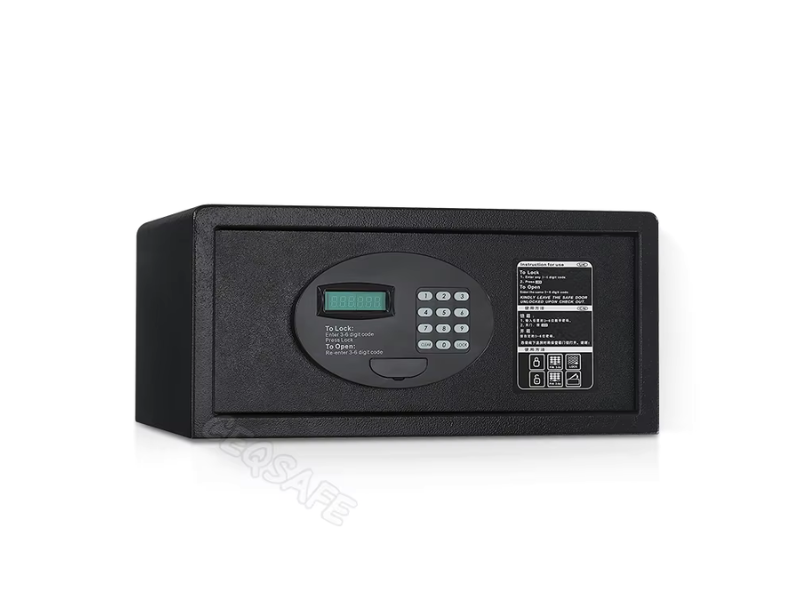
Now let's consider the main reason guest room safes have 5 sets of passwords:
Meeting Heirarchical Management Needs
All hotels have a strict system of management and 5 sets of management passwords is a perfect compliment to that system to make sure each employee has the right amount of control without going too far. This system of managing who has what control is critical to making sure that all management is systemically order and accountable.
Front desk staff, for instance, require daily access to assist guests, such as unlocking emergency safes or resetting passwords that guests have forgotten. During their cleaning, housekeeping teams may require little access to check the status of a safe to ensure that no cleaning has left behind any valuables. Engineering staff require access for maintenance or repairs, while security personnel need access for emergencies to deal with security issues. In the case of hotel disputes, managers need limited access for oversight of safes, and to assist in resolving disputes. 5 different sets of passwords means each of these jobs can have different credentials, and access can be tailored to their job, decreasing the chances of mishandling.
Unlike a single universal password that’s shared among all staff, hotels can separately manage their passwords, which allows hotels to track who accessed each safe and when. For example, CEQSAFE’s hotel safes keep a log of all management access, so if misplacement or security issues pop up, it’s simple to trace the movement of the access. With fewer passwords, this traceability is less possible.
All hotels experience a broad array of operational scenarios, and 5 sets of management passwords provide the operational flexibility to accommodate each of these scenarios quickly and efficiently while maintaining high security.
Sometimes guests report issues like forgetting passwords, losing access cards, or needing assistance after check-out. Staff can assist with issues like these more efficiently with front desk or guest services employee passwords, eliminating the need to consult a manager. For maintenance issues, the engineering teams can currently access the safes during off peak times with their specific passwords, to limit the disruption to guests that repairs can cause. In situations that require more immediate attention, like a fire or a medical emergency, security may need to access the safes quickly with their passwords. They will then be able to address the guest valuables or assist with a rescue that was stalling.
In more complex situations like a guest claim that an item was stored, having separate passwords for different positions would help the hotels to be able to access the logs, check who accessed the safe and when to clear the case. 5 different sets of passwords for the same function ensure that there are operationally responsive scenarios.
A Single Versus Distributed Password Management System
The 5 sets of managerial passwords split the potential single point of failures and, therefore, reduce the risk of complete access to the guest room safes. 5 sets of passwords improve the overall security.
Having Unique passwords can minimize disruptions for hotels and increase safey. If one password is hacked or if a staff member leaves without returning their access credentials, only one password needs to be changed instead of disrupting the operations of the entire hotel. CEQSAFE's hotel safes are designed to allow hotel managers to rapidly change passwords on individual safes, thus allowing hotels to change passwords quickly in the event of a compromise.
Moreover, the hotel staff's limited role access decreases the odds of unauthorized actions. For instance, a housekeeper will not be able to perform actions only a security staff can perform, and a front desk staff will not have access to the safety boxes as a maintenance staff. This division of roles not only is aimed at preventing their malicious use, but also at preventing the negligence or theft, and being able to mitigate the risks. And for hotels, these risks arecritical. The valuables stored in safes are directly your responsibility, and the management passwords are certainly a way to greatly mitigate that risk.
Staff Turnover
Staff turnover is a common occurrence within the hotel industry and the five sets of management passwords provide operational continuity when a staff member leaves the hotel or when new staff join the team.
Rather than providing temporary shared passwords that often get mishandled or forgotten, dedicated passwords that are specific for each role allow new employees to simply inherit the correct credential. When a staff member resigns, the hotel is able to change the password on only that one role, leaving the others unchanged. This helps streamline the hotel process of onboarding and offboarding employees.
For example, if a front desk steed resigns, the hotel only needs to reset the front desk management password, as opposed to all access passwords. CEQSAFE's safes allow for this with ease, having user-friendly systems where managing user access is simple. This retention of operational continuity is particularly beneficial to hotels that find staff turnover common to their industry.
For Compliance With Industry Standards and Liability Concerns
The majority of hotel associations and hotel industry regulators that recommend or mandate the implementation of multiple passwords to management level staff have defined security best practices. Regulatory best practices defined as having 5 sets mitigate the legal risk and liability gaps for hotels.
Hotels must protect guest valuables that are stored in room safes. When theft occurs, and adequate security is not in place, such as having only 1 shared password, lawsuits and fines are a risk. Hotels having 5 shared manager passwords on different security levels is, at minimum, a hotel demonstrating adequate security that will help reduce liability exposure from a claim.
CEQSAFE’s hotel safes having 5 manager password levels, along with detailed access auditing, satisfies an industry standard. Meeting this standard is about compliance with hotel regulations on guest protection and safety. Hotels help secure trust from guests when hotel security meets industry standards.
Safeguarding Guests Valuables in Large Hotels
For large hotels and hotel chains, multiple floors, buildings, or locations, 5 manager password levels scale operationally in a more efficient manner and simplify managerial accountability and control.
In a hotel with a large number of rooms, there is likely to be a number of different teams on each floor, such as a front desk team, a housekeeping team, and a security team. To accommodate each of these local teams with onsite control of their access, a set of 5 different passwords could be configured. For large hotel chains, the ability to implement the same 5 password security scheme across all properties enhances system uniformity, which is a major advantage for training and management.
CEQSAFE provides modular and highly integrated hotel management system compatible hotel safes with 5 management passwords, designed for hotels of all sizes to be maximally efficient and secure when scaling their operations from 50 to 500 rooms, and beyond.
Conclusion
The installation of hotel guest room safes with 5 sets of management passwords is justified from a security perspective. The design of the management password system provides hotels with a means to implement their operational design and logistics, security, and risk management strategies and, at the same time, fulfills the security industry requirements for such systems to include tiered access. The system fulfills the requirements of large facilities, with seamless inter-staff access control, operational continuity, and system design to service large facilities, as is common with hotels.
CEQSAFE Brand understands this need and has incorporated 5 sets of management passwords in hotel safes together with access logging, easy password resets, and hotel management system interfacing. For hotels, this effort is a systemic operational solution with positive outcomes in liability and trust with guests.
Operationally sensitive items like management passwords Integrated with hotel guests safes, Consolidate satisfaction with operational efficiency, Providing peace of mind and accommodating the unencumbered safety, access and operational protocols of the hotel, Rule with a clear purpose saftey and operational efficiency.

