
 EN
EN

What Makes Bank Vault Doors Reliable for Maximum Security Needs
Engineering and Construction of High-Security Bank Vault Doors
Modern bank vault doors rely on three core materials to achieve unmatched security: steel, reinforced concrete, and composite alloys. These materials work synergistically to resist cutting, drilling, and explosive attacks while ensuring long-term structural integrity.
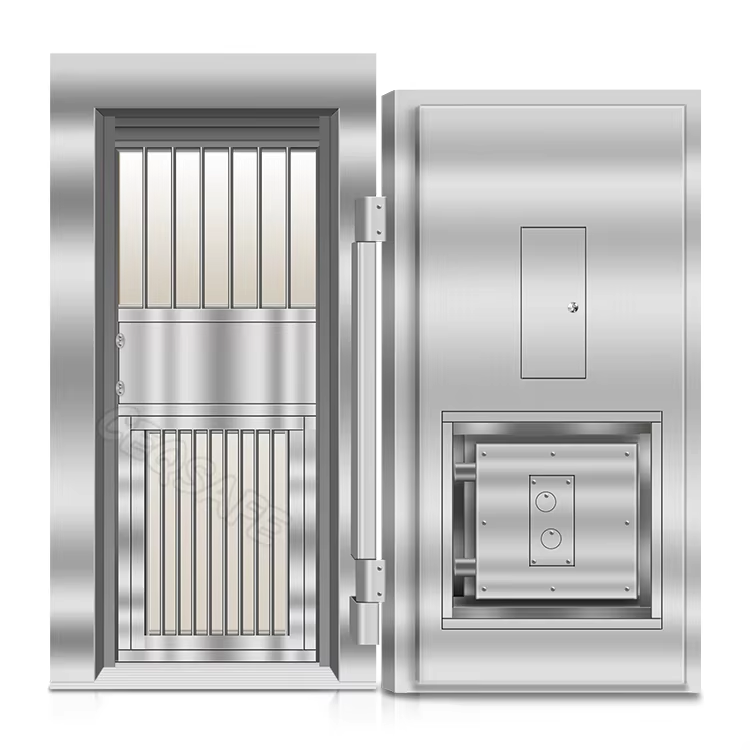
Core Materials Used in Bank Vault Door Construction: Steel, Concrete, and Composites
Most vault doors start with high grade steel around 10 to 14 inches thick as their base layer. This steel provides really strong protection against anyone trying to break in forcefully. Many manufacturers then add reinforced concrete on top, sometimes mixed with stuff like Kevlar or even titanium. The concrete helps protect against explosions and keeps things cool during fires. We're seeing more hybrid designs these days that bring in carbon fiber composites too. These materials cut down on overall weight while still keeping the door tough enough for serious security needs. This matters a lot for places where there's limited space available or buildings that can't handle too much extra weight on their foundations.
Steel Thickness, Grade, and Structural Integrity in Resisting Forced Entry
The go-to material for most vault doors these days is ASTM A572 Grade 50 steel because it has that impressive 65,000 PSI yield strength. When manufacturers install 12 inches worth of this steel plating on doors, they're looking at something that can hold up against cutting attempts for well over 200 hours straight according to those UL tests everyone refers to. Smart design choices matter too. The thickness isn't uniform everywhere actually thicker sections around hinges and locks help avoid creating soft spots where attackers might focus their efforts. And don't forget about the tempering process either which makes these doors much harder to penetrate using those specialized thermal cutting tools.
Reinforced Concrete and Hybrid Designs for Enhanced Durability and Blast Resistance
Subterranean vaults often employ walls with 36-inch concrete cores reinforced by steel rebar grids. Recent advancements include polyurea-elastomer coatings, which absorb shockwaves from explosions up to 20 PSI. Hybrid doors combining 8-inch steel with 18-inch concrete layers now achieve blast resistance equivalent to military bunkers at 40% reduced weight.
Advanced Reinforcement Techniques to Prevent Structural Compromise
Multi-axis cross-bracing and interlocking shear panels redistribute force across the entire door surface during attacks. Forged manganese steel bolts with diamond-cut threading resist sawing, while redundant re-locker systems automatically engage if primary locks are breached.
Case Study: Fort Knox Vault Door and Its 22-Ton, Blast-Proof Engineering
The Fort Knox vault door exemplifies engineering rigor, weighing 22 tons with a 21-inch steel-concrete composite structure. Its 144-point locking system and explosion-resistant door jamb endured 15,000 PSI during classified 2022 testing, as documented in 2023 blast-resistant engineering studies. This design has set benchmarks for subterranean facilities requiring multi-threat protection.
Security Features Integrating Physical Barriers and Access Control Systems
Layered Defense Strategy: Combining Physical Barriers With Electronic Security
Modern bank vault doors employ a defense-in-depth approach where 6-inch thick steel plates work in tandem with biometric scanners and motion sensors. This dual-layer protection ensures even if attackers breach the physical barrier, integrated electronic countermeasures like seismic detectors and infrared tripwires trigger immediate lockdowns.
Dual Control Combination Locks to Mitigate Insider Threats
Vault security protocols require two authorized operators to input separate codes simultaneously, a practice shown to reduce internal collusion risks by 81% (2024 Facility Security Report). This failsafe ensures no single individual can bypass authentication measures.
Time-Delay Locks as a Deterrent Against Forced or Fraudulent Access
Mandatory 15–45 minute waiting periods activate during unauthorized entry attempts, with 97% of criminals abandoning efforts within 8 minutes (UL 608 Security Testing Standards). Mechanical timers complement digital systems to prevent circuit manipulation.
Integration of Biometrics, Alarms, and Intrusion Detection in Modern Bank Vault Doors
Facial recognition systems cross-reference live feeds against centralized access databases while pressure-sensitive flooring detects abnormal weight distributions. These features create a 360° security net that adapts to evolving threats through machine learning pattern analysis.
Types and Performance Comparison of Bank Vault Doors
Solid Steel Vault Doors: Strength and Application in High-Security Environments
Steel bank vault doors are still considered the best option when it comes to physical security, especially those between 4 inches thick up to around 10 inches in really high risk locations. The doors are made from tough steel alloys like ASTM A572 or MIL-S-46100 which makes them stand up pretty well against cutting equipment and those big hydraulic jacks that thieves sometimes try. Take a 6 inch thick door for instance it can hold off a torch attack for something like 30 minutes because of how solidly constructed they are throughout. These kinds of doors work great for banks at street level where having something visibly strong helps scare off would be robbers and their crews.
Reinforced Concrete Vault Doors for Subterranean and Risk-Prone Facilities
When it comes to buried or bunker style installations, most rely on heavy duty concrete vault doors that have been strengthened with rebar grids and coated with epoxy protection. The blast resistant capabilities of these structures can reach around 50 psi, which is really important stuff when building facilities close to places where conflicts happen or natural disasters strike regularly. Take a standard 12 inch thick reinforced concrete door for example it typically clocks in at about 8 tons. That kind of weight makes retrofitting existing buildings almost impossible, though these doors work great as part of new construction projects especially in areas known for frequent earthquakes.
Composite and Combination Designs Balancing Weight, Space, and Protection
Hybrid doors combine 3/8 inch steel plates with ceramic fiber materials, giving them around 80 percent of regular steel strength but weighing only half as much. According to tests run by the U.S. Treasury back in 2023, these doors can hold up against angle grinders for about twenty whole minutes and offer improved protection from those nasty thermal lance attacks too. The modular design works really well for vault installations or older structures where building codes limit what kind of heavy duty stuff can be installed. Many banks and museums have started switching to this type because it fits within existing frameworks without requiring major structural changes.
Performance Comparison: When to Choose One Type of Bank Vault Door Over Another
| Factor | Solid Steel | Reinforced Concrete | Composite |
|---|---|---|---|
| Attack Resistance | 30+ min torch/cutting | 50 psi blast | 20 min grinding |
| Weight | 5–22 tons | 8–15 tons | 1.5–4 tons |
| Installation Cost | $18k–$45k | $25k–$60k | $12k–$30k |
| Best Use Case | High-risk urban banks | Military bunkers | Retail vault retrofits |
Prioritize solid steel for direct physical assaults, concrete for subterranean explosive risks, and composites when balancing budget, space constraints, and mid-level threats.
Locking Mechanisms and Multi-Point Engagement Systems in Bank Vault Doors
Mechanical Locking Components: Bolts, Gears, and Rotational Cams
Bank vault doors rely on hardened steel bolts (8–14 in length) and precision-machined gears to create physical barriers against forced entry. These components withstand over 5,000 lbf of tensile force, with rotational cams ensuring synchronized bolt movement. Mechanical systems adhere to UL 437 standards (2023 update), requiring 15+ minutes of resistance to drilling attacks.
Multi-Point Engagement Systems for Uniform Force Distribution and Tamper Resistance
Modern security doors use 12–24 point engagement systems that distribute stress across door frames and jambs. As shown in security engineering studies, 5-point locking mechanisms reduce torsion-induced failures by 63% compared to single-bolt designs. This uniform engagement prevents concentrated weak points vulnerable to hydraulic jacks or thermal lances.
| Locking Points | Pry Resistance (Minutes) | Axial Load Capacity (lbs) |
|---|---|---|
| 5-point | 28 | 12,400 |
| 12-point | 42 | 18,700 |
Mechanical vs. Electronic vs. Hybrid Lock Systems: Reliability and Vulnerabilities
While mechanical combination locks maintain 99.99% operational reliability (Federal Bank Security Report 2023), electronic systems enable remote access control but introduce cybersecurity risks. Hybrid solutions pair biometric scanners with physical keys, balancing auditability (digital logs) with EMP/fire survivability.
Balancing Digital Innovation with Mechanical Fail-Safes in Bank Vault Door Security
Leading security providers now integrate iris scanners with spring-loaded deadbolts that automatically engage during power outages. This redundancy ensures compliance with ANSI/BHMA A156.5 (2022) grade-1 requirements while preventing single-point failure scenarios common in fully electronic systems.
Resistance to Physical Attacks and Compliance with Security Classifications
Performance under attack: cutting, drilling, and explosive resistance testing
Vault doors need to go through pretty intense testing before they get certified for actual bank use. The whole point is to make sure they can hold up against all sorts of modern breaking techniques. Manufacturers actually recreate break-in scenarios by testing with things like hydraulic jacks, those super sharp diamond drills, and even explosive devices. Doors rated under UL 752 standards have shown they can resist forced entry attempts for around an hour when put through standard ballistics and explosion tests. When it comes to how these doors perform under pressure, there are specific measurements taken. For example, blast resistant models need to handle temperatures reaching as high as 1200 degrees Fahrenheit. And if someone tries drilling into them, the door should be able to stop a 0.5 inch carbide bit from getting through within 180 seconds. These numbers aren't just random figures either they represent real world protection levels that banks rely on day after day.
Thermal and explosive protection in UL-classified vault doors
Today's UL-rated vault doors are built with multiple layers to protect against both heat and blasts. Inside these heavy-duty doors sits fireproof composite materials combined with ceramic insulation that can handle temps well over 1,700 degrees Fahrenheit. The steel frame isn't just there for show either it actually spreads out blast energy sideways when something goes boom. Most security professionals really rely on doors that meet the ASTM F1233 standard. These specs basically say the door needs to survive a blast pressure of 4.5 psi from explosives similar to C4 without letting the locks fail. That's pretty impressive considering what these doors are designed to face in real world situations.
Case study: Federal Reserve Bank of New York’s 90-ton rotating vault door
The famous 90-ton vault door at the Federal Reserve stands as a prime example of how to build something that really resists attacks. Back when they tested it against those old fashioned blowtorches from the 1950s, it took almost 43 hours before anyone could get through during certification tests. What makes this door so tough? Well, it has these nine layers made from both steel and concrete working together. Plus there's this rotating cylinder part with walls that are 18 inches thick. And let's not forget about the impressive 140-point locking mechanism. All these features work together to stop all sorts of threats at once whether someone tries fire, force, or even explosives. This kind of security setup actually became a model for protecting important infrastructure around the country.
Understanding UL ratings and U.S. government standards (Class M, Class 1–3)
Security classifications prioritize threat-level responsiveness:
- Class M (Military Grade): Requires withstanding military-grade explosives and 12+ hours of sustained attack
- Class 1 (Maximum Security): Mandates 30-minute resistance against oxy-acetylene cutting tools
- Class 2–3 (Commercial): Designed for 5–15 minute protection against common burglary tools
Regulatory alignment ensures vault doors meet operational requirements, from retail bank branches to nuclear containment facilities.
FAQ Section
What materials are primarily used in the construction of bank vault doors?
Bank vault doors are primarily constructed from steel, reinforced concrete, and composite alloys. These materials provide resistance to cutting, drilling, and explosive attacks.
Why is steel thickness important in vault doors?
Steel thickness is crucial because it provides strong protection against forced entry. Thicker sections around hinges and locks help prevent attackers from exploiting weak spots.
How do hybrid vault doors differ from traditional ones?
Hybrid vault doors combine materials like carbon fiber composites and steel to reduce weight while maintaining high security, ideal for locations with space or weight constraints.
What is the significance of UL ratings in vault doors?
UL ratings indicate the level of protection a vault door provides. These ratings ensure doors meet specific standards for resistance to cutting, drilling, and explosive forces.
How do multi-point engagement systems enhance vault door security?
Multi-point engagement systems distribute stress across the door, reducing the risk of failure at any single point. This system is crucial for resisting forced entry attempts.

